
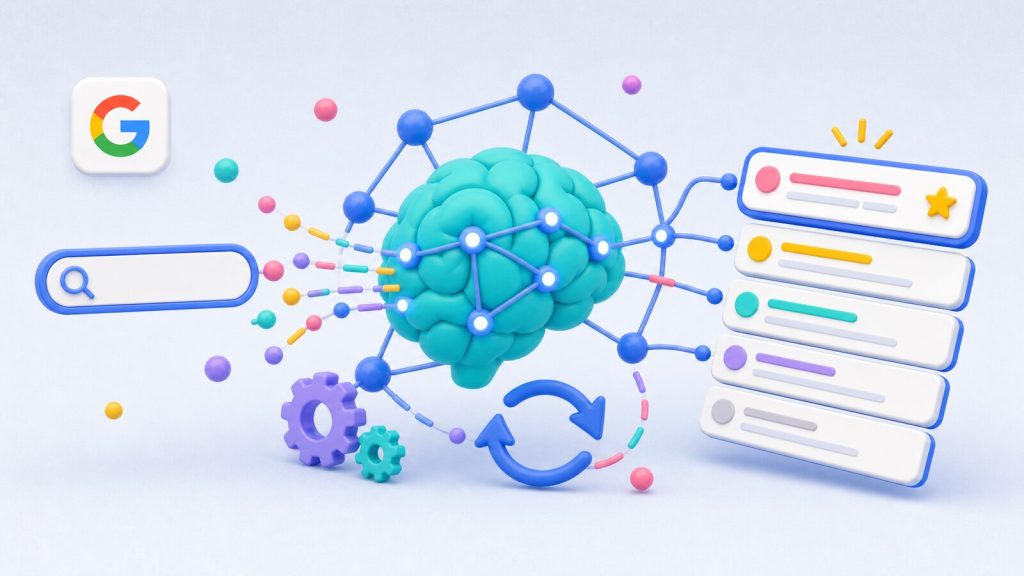
Google RankBrain — that’s the subject of this lesson. What is Google RankBrain and how does it work? How often is it updated? Which queries has it affected? What effects have this Google algorithm and the various RankBrain updates had — and still have — on the way SEO itself is done?
We’ll cover all of that, plus neural matching, machine learning and artificial intelligence… there’s a lot to get through.
As you’ll know, in our SEO Academy we cover every topic connected to search engine rankings. If you’re new here, have a look at the earlier lessons — we’ve covered a number of things that will help you follow this one.
If this lesson interests you, it’s probably because you want to understand exactly what Google RankBrain is and how to optimize content for RankBrain, so as to make your SEO strategy more effective and hit your business goals.
Let’s get going!
Want to become an SEO guru?
Thinking about starting a career in SEO?
Got a site you want to optimize for search yourself?
Get in touch and ask about our SEO courses!
I want more info
What is Google RankBrain?
RankBrain is a Google algorithm that uses machine learning (find out more) — that is, artificial intelligence — to filter search results and give users the most relevant ones. Google RankBrain isn’t a standalone algorithm but an integral part of Google’s overall algorithm (Hummingbird).
The precise definition and explanation come from Greg Corrado, co-founder of Google’s deep learning team, in an interview with Bloomberg in October 2015.
RankBrain uses artificial intelligence to embed vast amounts of written language into mathematical entities — called vectors — that the computer can understand. If RankBrain sees a word or phrase it isn’t familiar with, the machine can make a guess as to what words or phrases might have a similar meaning and filter the result accordingly, making it more effective at handling never-before-seen search queries.
Greg Corrado

Which queries does RankBrain affect?
Released in April but confirmed on 26 October 2015, Google RankBrain doesn’t process every query — only those whose meaning isn’t clear.
According to information Google has published, “15% of the searches we process each day have never been seen before”. In numbers, that’s roughly 450 million queries a day. RankBrain exists precisely to help filter those results, and during 2015 the Mountain View company itself named it one of the three main ranking factors.
How does Google RankBrain work?
Having seen what Google RankBrain is, let’s look more closely at how it works and what makes it different.
In short, before RankBrain, Google scanned pages looking for the exact keyword the user had typed into the search box. Today, much like a human, it tries to work out the user’s search intent and serve relevant results. How? By turning keywords into so-called entities — “concepts” whose meaning Google knows.
What are entities? They’re “objects”, “facts” about people, places and things that Google already holds a great deal of information about and can return accurate search results for. When Google meets unknown or ambiguous search terms, a mathematical algorithm splits entities into more specific words called vectors, which lead to particular SERPs.
Because similar vectors lead to similar search results, Google can match queries to results likely to satisfy the searcher. This works through the analysis of patterns, models, historical search data and user interaction with queries as measured by certain metrics (CTR, bounce rate, dwell time, pogo-sticking).
Machine learning
The single most important thing Google RankBrain brought is an understanding of future queries relating to a given topic.
In other words, Google’s algorithm can now learn on its own and improve its own ability to process results and serve content. That comes from spotting complex, apparently unrelated search paths, from a stemming algorithm (find out more), from lists of words and synonyms, and from a database of connections to concepts (entities).
The difference between machine learning and neural matching
Machine learning algorithms use mathematical and computational methods to learn information directly from data, without predetermined mathematical models and equations.
Neural matching is an AI-based system that helps the Google algorithm understand in depth the context a term is used in.
The difference between the two was explained in a tweet by Danny Sullivan when, after Google’s March 2019 Core Update, interest in neural matching returned. Sullivan himself had announced its use in a tweet on Google’s twentieth anniversary.
Image from twitter.com and google.com
Sullivan sums the difference up like this:
RankBrain helps us better relate pages to concepts; neural matching helps us better relate words to searches.
Want an SEO analysis of your site?
Want to know how many keywords you rank for on Google?
Want to know your website’s organic traffic?
Want to know who your competitors are and how they’re performing?
Want to know the number of backlinks pointing to your site?
No problem, we’ll tell you. FREE!
Google RankBrain: a worked example
Bloomberg’s article “Google turning its lucrative web search over to AI machines” gives the following example.
For the query “What’s the title of the consumer at the highest level of a food chain”, the word “consumer” can carry the sense of “someone who makes purchases”. But in a scientific context the same word denotes a sub-level of food consumers, which in this example means those at the top of the food chain — predators.
For that query Google returns this result:
Image from google.com
Now let’s vary the query slightly, simplifying it to “top level of a food chain”. The result is this:
image from google.com
As you can see, the SERPs are similar, because RankBrain spotted the relationship between the two queries even though they use different words. RankBrain looked at pages containing the keywords “top level” and “food chain” and noticed that in historical queries where those two phrases appeared (in relation to two factors, concept and context), the SERP results were about “predators in the animal world”.
Google starts from what it knows in order to answer what is unclear or ambiguous to it.
How does Google RankBrain change SEO?
RankBrain represents a significant shift in the way SEO is done. Understanding the user’s exact search intent, and which content will be most useful to them, becomes the priority. Seen that way, the move from a keyword focus to a topic focus was inevitable.
In modern SEO, the idea of one page per individual keyword to climb the SERPs looks to have been retired. With RankBrain, building separate pages for plural forms of the same keyword or its variants (with their own URLs) is a strategy that no longer works. Far better to fold it all into a single page covering the topic as broadly and thoroughly as possible.
Take the queries “landing page”, “landing pages” and “landing page example”. RankBrain now understands these are keywords about the same subject, and returns similar results.

How do you optimize content for RankBrain?
Which SEO tactics to deploy depends on a number of things, and some are common practice by now, but broadly the recommended ones are these:
- Optimizing metadata (the title tag and the meta description tag)
A high click-through rate (CTR) is one of the signals Google RankBrain weighs when judging the quality and relevance of a page. One way to make a visitor more interested in a piece of content runs through optimizing these two pieces of metadata.
Here’s some practical advice from Brian Dean, one of the best SEOs around:
- Write titles that stir some emotion in the visitor, using modifiers — words such as guide, best, example, 2019, and so on.
- Use brackets (round or square) at the end of your titles, for example: Local SEO (updated 2019 guide)
- Keep the title within 55–60 characters
- Use numbers in your titles (ideally with a decimal place)
- Write a meta description that, like the title, conveys or stirs an emotion
- Make sure the meta description contains the focus keyword and the relevant common terms used in paid ads
- Optimizing the content
- Search intent: shift your focus from the keyword to concepts, so your content captures the meaning the visitor has in mind — and use natural language while you do it.
- Term frequency – inverse document frequency: use tools such as SEO-hero to see which relevant terms your competitors use in their content.
- Completeness: cover the topic in depth and add external links to content that provides supporting information.
- Cutting bounce rate and raising dwell time
Bounce rate and dwell time are also signals Google RankBrain uses to judge a page’s relevance. The first measures how often users abandon a page; the second measures how long visitors spend on a page before leaving.
To move those numbers, the recommended on-page SEO tactics are:
- Put the content in front of the user straight away, rather than leading with images or other non-text elements.
- Use an introduction of no more than 100 words containing the focus keyword (or variants and synonyms) and capable of creating engagement.
- Publish content of at least 2,000 words that answers the searcher’s informational needs in depth.
- Take care to break the text up with a subheading roughly every 200 words.
- Reworking existing content
Use Google Search Console to find pages with a low CTR, or that are no longer fresh, and decide whether to remove them or improve them through SEO optimization.
- Build awareness of your brand
When buying online we often choose a brand we know over an unknown one with a better offer. In the same way, a user familiar with a brand is twice as likely to click one of its paid ads and to convert.
One tactic for lifting brand awareness — and with it CTR and bounce rate — is social ads: advertising aimed at a specific target audience on the major social networks.
Conclusion
In this lesson of your favourite SEO Academy we’ve covered Google RankBrain and given you what you need to understand how it works and how to optimize content for it.
Search engines are constantly trying to improve how they serve users relevant, accurate results for a given query. Machine learning, artificial intelligence, neural matching, semantic SEO — these are important developments that change how SEO is done, and we’ll keep covering where they lead in the lessons ahead.
Stay tuned and keep following us — in the next lessons of the SEO Academy we’ll get into plenty more interesting territory…
Want to improve your site’s SEO ranking? Want to optimize your site, get found by your customers on Google and beat the competition? Get in touch! We’ll work out the best SEO strategy for your site.
Want to sharpen your SEO knowledge? Get in touch! We’ll find the right SEO course for you.
Want to ask us something or just talk to us? Get in touch! That’s what we’re here for.