
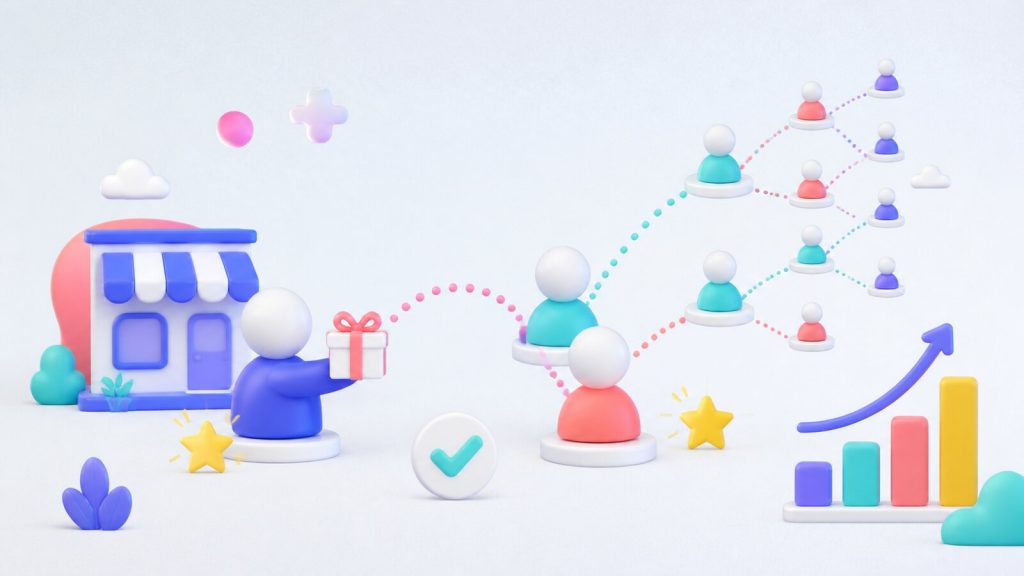
Welcome, or welcome back, to our ever-growing Growth Hacking Academy! Having covered A/B testing, SimilarWeb and marketing strategies in recent lessons, this time we want to talk about the referral programme.
The term is easily confused with the better-known affiliate programme. Which is why we’d encourage you to follow this lesson closely, so you can tell them apart and choose the one that fits your business.
In the meantime, how about becoming a referrer of ours by recommending your favourite Academy or sharing its lessons on social? It’s easy — just click the buttons above.
Need a list of growth hacking tools?
Need tools to grow your business? Want to use growth hacking for your clients and work out which tools are available? No problem, we’ll give you the full list. FREE!
Request the free growth hacking tool list
What is a referral programme?
Has a friend or acquaintance ever asked you for a doctor, a plumber, a travel agency — any contact they needed at that moment and that you were happy to recommend? Good. Did you give them a phone number, an email, some way of getting in touch? Congratulations: you were an unwitting referrer.
You recommended someone or something on the basis of your own good experience. Your opinion carried weight because it conveys your positive judgement and because the person who asked trusts you.
That example describes a spontaneous referral — classic word of mouth (WOM). It happens naturally, with nobody expecting anything in return beyond perhaps a friend’s gratitude and the satisfaction of having been useful.

Even in spontaneous word of mouth we can pick out two essential elements:
- the trust the person receiving the recommendation places in the referrer (the one doing the recommending);
- the good experience that moves the referrer to recommend a product, service or professional.
A referral programme in digital marketing is marked by one further important element: an incentive, generally promised both to the referrer and to the friend they refer.
Why to both?
The referrer, because they effectively become an ambassador and put their own face in front of people they know. Without the double incentive the referrer could look as though they’re profiting from a friend, and that friend might grow wary of them.
By offering something appealing to both, you create a win-win that also favours the company, which — at minimal cost, or a slightly reduced margin, compared with a far more expensive advertising campaign — can drive a strong rise in sales.
Are referral programmes and affiliate programmes the same thing?
It’s very easy to muddle these two marketing strategies which — no — are not the same thing. The strategy and the people involved differ substantially. Let’s unpack it.
What affiliate marketing is
Affiliate marketing is a commercial arrangement between an advertiser (a company wanting to sell its service or product) and an affiliate (the person promoting that product or service). A third party can sit between them, the affiliate platform, acting as intermediary and handling conversion tracking and payments (source: Wikipedia).
In practice an affiliate programme offers a commission to marketers, bloggers and industry leaders (called affiliates here) for the sign-ups they bring.
Image from programma-affiliazione.amazon.it
Take an example we all know: Amazon. On many blogs and sites, books or other goods sold by Jeff Bezos’s company are recommended or reviewed. Click through and you can buy directly from Amazon. The price is identical to the one on the ecommerce platform, but the blog or site you clicked from receives a commission for having brokered the purchase.
The differences between referral marketing and affiliate marketing
The differences are substantial. Referral programmes stake almost everything on relationships with customers, who feel involved and comfortable sharing their good experience with others.
New customers also feel privileged at being welcomed with an incentive, and that builds loyalty.
Referral marketing may produce lower traffic than an affiliate programme, but it brings higher-quality leads and a better conversion rate. It’s a strategy aimed more at medium- and long-term results.
In affiliate marketing the customer isn’t involved and the relationship is almost entirely absent.
For a deeper look at the differences between the two, we’d recommend this thorough article. Here it is.
Need a list of growth hacking tools?
Need tools to grow your business? Want to use growth hacking for your clients and work out which tools are available? No problem, we’ll give you the full list. FREE!
Request the free growth hacking tool list
How do you build a good referral marketing strategy?
Studies going back to 2010 show that customers arriving through referral programmes are generally more profitable and more loyal than others, with a higher contribution margin and a higher retention rate.
The referral programme is a precise instrument, because a referrer knows the tastes and needs of the people in their circle better than anyone — so those leads are squarely on target and high in value.
The golden rules
It matters enormously that the referral programme is made known and promoted consistently across every channel and every commercial touchpoint — even on invoices, if need be.
One good strategy is making the referrer feel important, chosen from among your best customers. Equally important is making the promised incentive available quickly, both to the referrer and to the person they referred, at the moment of purchase.

Beyond the conversion itself, it’s essential to gather as much meaningful data as possible about the referred customer, linking them to their referrer, so that effective lead nurturing can follow.
If you go for an incentive tied to a code, take care to always use a one-time code, so the same incentive can’t be used repeatedly.
Have you ever thought of your own employees as referrers? Give it some thought. Who knows your business better? Give them value — it’s a good tactic.
Another effective choice can be partnering with other companies so as to widen the offer to everyone’s advantage.
Which incentive should you choose?
This question, and the answer to it, is the heart of a good referral programme strategy.
Let’s say straight away that there’s no correct answer, and that a period of testing is always needed to work out which solution best fits your business.
Given that we always recommend the double incentive (going to both the referrer and the referred friend), here are a range of options to think about.

- Loyalty points
- Cashback
- Coupons
- Store credit, in a physical shop or online
- A free month, or a shorter period, on subscriptions (think Netflix)
- Gift cards
- Discounts, in absolute terms or as a percentage of the new customer’s purchase
- Access to special content, downloadable perhaps (guides, ebooks, exclusive video and so on)
- Upgrades or access to special features (in an app, for instance)
- Physical prizes or merchandise (offline as well as online)
- Free shipping
Imagination has no limit, so you’ll easily think of other options. What matters is calibrating them to the kind of business you run.
Does referral marketing get you quality leads for nothing?
Referral marketing doesn’t reach the point of acquiring leads at zero cost, because you still have to give something in return.
It’s true, though, that the costs are very low, and it’s certainly a low-cost marketing strategy.
If you go for a discount or a credit, for instance, your margin is slightly lower. If you decide to bear a cost such as a voucher or a percentage of the transaction, you’ll have a real cost — but one you can assess and set from the outset. The marketing cost is clear from the start.
One thing is certain: the outlay happens after a purchase has actually been made and a new customer genuinely acquired, unlike traditional advertising campaigns.
Not convinced referral programmes work? Look at this article from ReferralCandy describing 77 examples of referral programmes. Here it is.
Which tools help?
Running a referral programme isn’t a simple business, offline and especially online. But as in every corner of digital marketing, there’s no shortage of tools for automating the whole thing.
The best known are:
- Ambassador (go to site)
- Referral SaaSquatch (go to site)
- TapMango (go to site)
- ReferralCandy (go to site)
For a fuller overview, here’s the comparison table produced by Capterra and the article it belongs to, with detail on every tool listed. Here it is.
Image from Capterra.com
Conclusion
In this lesson of your favourite Growth Hacking Academy we’ve covered the referral programme, referral marketing and how it differs from affiliate marketing. We then went through the most effective strategies to adopt and the kinds of incentive to offer. And we finished with a clear comparison of the best tools for automating the whole referral operation.
Had you ever considered this kind of marketing strategy? Keep following us and your horizon will keep widening.
See you at the next lesson.
Want advice on increasing sales? Get in touch! With growth hacking we’ll work out and implement the best strategy for reaching your goal.
Want to become a growth hacker? Get in touch! We’ll find the right course for you.
Want to ask us something or just talk to us? Get in touch! That’s what we’re here for.