
Ignoring off-page SEO and assuming that optimizing on-page SEO is enough to make a website or a blog successful will get you… precisely nowhere.
As we saw in the previous lesson of our Academy, there are essentially two ways to optimize a website so that it becomes more visible to Google and lands on the first page of the SERP.
Those two ways are:
- On-page SEO
- Off-page SEO
In this article we’ll cover how to optimize a page through off-page SEO, also called off-site SEO.
Want to become an SEO guru?
Thinking about starting a career in SEO?
Got a site you want to optimize yourself?
Find out all about our SEO courses!
I want more info
What off-site SEO is: the simple explanation
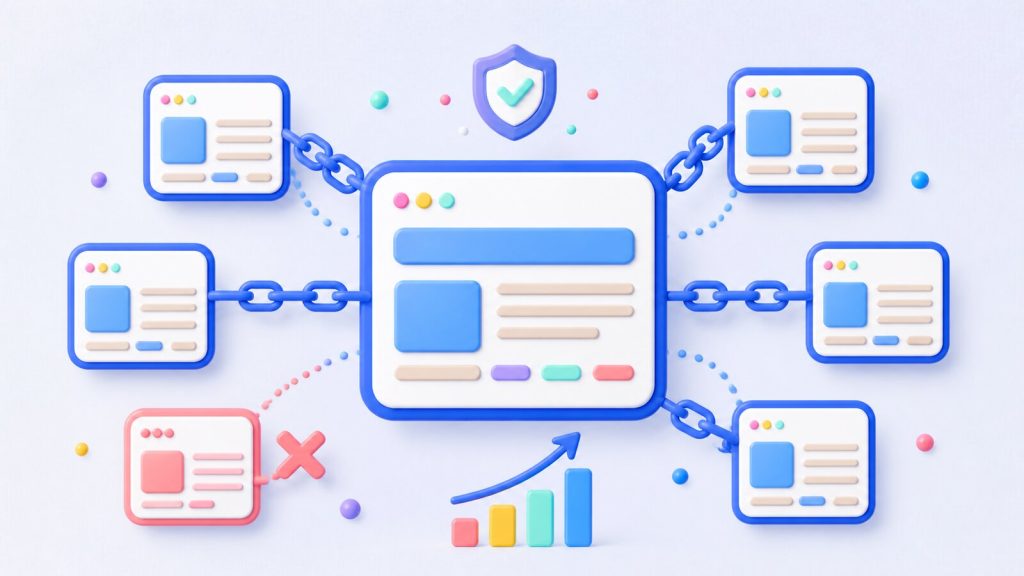
Off-page SEO, also known as off-site SEO, affects how your site is indexed, but it doesn’t require you to change anything inside the site itself.
In practice, off-site SEO means working outside your website to generate external links pointing back to it. That’s also what people mean by “link building” — building a network of external links. That’s the job, in plain terms.
Now let’s look at how it’s done.

How to do off-page SEO
Neglecting off-site SEO is one of the most common mistakes made by people who launch a website or a blog and hope to succeed simply by publishing articles, without ever thinking about link building.
Doing both on-site SEO and off-site SEO is essential to a site’s success, and the two go hand in hand: doing one without the other is like owning a car with no engine. It won’t go anywhere.
To avoid that mistake, here’s how to do off-page SEO effectively, even if you’ve never heard of it or have very little experience.
Link building or back linking: what they are and how to do them
Link building, sometimes also called back linking, means creating high-quality external links — they have to come from authoritative sites, ideally close to your site’s subject matter.
Here’s how:
- Bet on article quality: this is the “natural” way to earn backlinks, because if people like what you publish they’ll share it spontaneously on their own social profiles and their friends’.
- Similar blogs and sites: look for blogs covering topics close to yours and propose exchanging links. In practice the other blog mentions you in its articles and you do the same for theirs.
- Guest posts: writing and publishing articles on other blogs. As well as being a way to do link building, it’s an excellent opportunity to widen your network and get noticed by an audience beyond your usual readers.
- Google+: even though very few people use Google+ these days, it carries some weight for Google ranking, being one of Google’s own properties.
- Social media: sharing your articles on social matters a great deal, and if it’s worth it, promoting them to reach a wider — and above all better-targeted — audience. Facebook is a good place to share your articles; LinkedIn is often even better (though it depends heavily on the subject).
Off-site SEO can be risky in one respect. We’d advise against letting just anyone host your links on their site or platforms: not every site is authoritative, and low-grade backlinks do you no good. So make a point of doing link building cleanly and getting linked only by competent, authoritative sites.
Want an SEO analysis of your site?
Want to know how many keywords you rank for on Google?
Want to know your website’s organic traffic?
Want to know who your competitors are and how they’re performing?
Want to know the number of backlinks pointing to your site?
No problem, we’ll tell you. FREE!
A few useful SEO tools
- If you’re planning off-page SEO work, there’s a piece of software that will definitely help: SEMrush, one of the most complete SEO platforms around.
We use it ourselves for analysis and SEO optimization work.
From an off-page SEO point of view it’s particularly useful for backlink analysis. SEMrush includes a tool that tells you how many backlinks point to your site, which ones they are, and what quality they’re at. - If you want something very similar but aimed (for now) only at the Italian market, we recommend SEOZoom.

Conclusion
In this article you’ve learned how to do off-page SEO and how important it is if you want to rank your site’s pages as high as possible in search engines. We’ve written plenty of other articles in our SEO Academy where you’ll find everything you need to understand how each individual ranking factor works.
Want to optimize your site, get found by your customers on Google and beat the competition? Get in touch! We’ll work out the best SEO strategy to finally do what you haven’t managed so far.
Want to sharpen your SEO knowledge? Get in touch! We’ll find the right course for you.
Want to ask us something or just talk to us? Get in touch! That’s what we’re here for.