
![Link building [SEO]: cos’è e come si fa](https://euwebagency.com/wp-content/uploads/2019/03/0078-link-building-1024x576.jpg)
Link building — that’s the subject of this lesson. What link building is, how to do it without running into Google penalties, how to define and implement effective link building strategies, which techniques and tactics a link building expert uses, and which link building tools and software they reach for.
We’ll cover all of that, plus local link building and link building for ecommerce… as you can see, there’s plenty to get through.
As you’ll know, in our SEO Academy we cover every topic connected to SEO rankings. If you’re new here, it’s worth looking at the earlier lessons — we’ve covered a number of things that will help you follow this article.
If this lesson interests you, it’s probably because you want to learn and use link building techniques to improve your site’s or blog’s ranking. So let’s not hold back — here we go!
Want to become an SEO guru?
Thinking about starting a career in SEO?
Got a site you want to optimize for search yourself?
Get in touch and ask about our SEO courses!
I want more info
Link building: what it is and why it matters
In this first part we want to unpack the idea of link building — what it is and why it matters so much within an SEO strategy.
Link building defined
Link building is a set of SEO techniques aimed at acquiring links from authoritative sites. Hyperlinks (or links) are the connections that let a user navigate and quickly find content within a website’s structure.
They differ from URLs (Uniform Resource Locators), which are alphanumeric strings uniquely identifying the address of a resource (a document, image, video and so on) on the internet.
What link building means
In SEO (Search Engine Optimization), when an external website “links” to a page on yours, that link (known as a backlink, external backlink or inbound link) is read by Google as a quality signal.
The quantity, relevance and quality of links build the linked page’s authority (link popularity), improving where it ranks in the SERP for a given keyword.
In traditional link building, acquiring (artificial) links is expressly aimed at ranking on search engines and assumes some kind of exchange — money, links or something else. The modern approach favours acquiring links naturally and voluntarily, without an exchange; that’s what natural links and link earning mean.
Sometimes artificial links are acquired automatically through software, which is known as link building automation.
Why link building matters
In 2015 a study run by Moz (here it is) showed a correlation between the number of backlinks pointing to a page and its ranking on Google.
The research examined the top 50 results in the SERP for roughly 16,521 highly competitive keywords. It found that 99.2% of all websites had at least one external link, and 77.8% of the pages appearing in the top positions had at least one external link pointing at the page.
The supposition became a certainty the following year, when Andrey Lipattsev, Google’s Search Quality Senior Strategist, said in an interview that links are the number one ranking factor (more here).
Image from moz.com
The benefits of link building
Having covered what link building is, here in short are some of the advantages this form of online marketing offers:
- Domain & Page Authority: quality links (relevant to the topic and coming from authoritative sites) raise the overall authority and trustworthiness of a page, and of the site as a whole.
- Brand visibility & authority: link building, done through guest posting for instance, can raise brand awareness. Publishing quality content can gradually lead to a company or brand being seen as an authority in its field.
- A higher conversion rate (CR): link building can increase traffic to a site, with a likely rise in conversions.
- Better SEO rankings: link building can have a significant impact on organic rankings and on a site’s indexing.
- A long-term investment: where paid ads and other traditional marketing give visibility for a limited time, an investment in link building lasts as long as the link to the page stays live.
How to do link building for free
There are plenty of advantages to developing a link building strategy, but the techniques and tactics involved need handling with real care.
The main reason is the use of SEO link builders and of black-hat and grey-hat strategies. Those tactics carry a high risk of manual and/or algorithmic penalties from Google, and are best avoided.
Done badly, link building can do serious damage, which is why we recommend turning to SEO agencies or SEO experts offering link building services — at the very least for advice on the strategy to adopt.
In the sections ahead we’ll look at how link building is done properly, which white-hat strategies and techniques to use, and the steps to follow. Along the way we’ll use some tools (for link intelligence and link prospecting) and refer to metrics and KPIs, which we’ll describe.
Link building tools & software
There are plenty of tools and software packages you can use: Majestic, SEMrush, Moz, SEOZoom, Ahrefs and URL Profiler.
The last two are the ones to prefer. Ahrefs is an excellent link building analysis tool that, alongside its “historic” and “recent” indexes, has a “live” index letting you see the backlink list in real time. URL Profiler proves particularly useful because it can pull together SEO metrics from different tools (Ahrefs, Majestic and so on) for thousands of URLs at once.
Link building: metrics & KPIs
Here in short are the main metrics and KPIs used to monitor and judge the effectiveness of a link building campaign, build a link profile or choose which sites to seek links from.
- Link popularity: a measure of how trustworthy a site’s content is, and a fundamental factor in Google’s PageRank.
- Referring page: the page or site the link comes from.
- Anchor text: the clickable text inside a link that tells the user what the target page’s content is.
- Domain Authority: Moz’s metric for a domain’s authority. Treated as the reference metric, DA runs from 1 to 100, where a higher value means greater authority.
- Domain Rating: Ahrefs’ metric for a domain’s authority. DR runs from 1 to 100 and is assigned according to the number and quality of the analysed domain’s backlinks.
- The rel=nofollow attribute: an HTML tag telling search engines not to pass popularity from one page to another.
- The rel=dofollow attribute: an HTML tag telling the search engine that the link carrying it should be followed and indexed.
![Link Building [SEO]: What It Is and How to Do It | SEO Academy](https://euwebagency.com/wp-content/uploads/2019/03/0154-link-building-1.jpg)
How to run an SEO link building campaign
An SEO campaign aimed at building links usually involves at least these phases: link profile, link prospecting and link building outreach. Each is carried out in defined steps.
SEO audit
Before doing link building — before thinking about off-site SEO at all — it’s good practice to run a technical SEO audit. Whatever on-page SEO work turns out to be needed will make the link building itself more effective. On-page factors to check and correct include:
- Site structure and architecture, and internal linking
- Site speed (use Google PageSpeed Insights, GTmetrix or YSlow)
- Duplicate content
- rel=canonical errors
- Errors in the page’s HTML caused by:
- Duplicate or missing metadata
- Broken external links
- Incorrect use of directives (noindex, nofollow and so on)
- 301 redirects, and 302s that should be 301s
Campaign goals
Link building is a form of marketing, and as such the first job is to define the goals of the campaign. They should be S.M.A.R.T. and aligned with the organisation’s wider goals. Specifically, define:
- the aim: more web traffic, better rankings for specific keywords, or both;
- which URLs need links: the homepage, product pages, category pages;
- the types of link: links carrying your brand or company name, links with exact-match anchor text;
- the target audience: who your possible link prospects are;
- the content: whether these backlinks should point to existing content or to content still to be created.
Link profile
The link profile is a report summarising the results of the link building analysis carried out by an SEO specialist or a link building agency to establish the current position. It includes:
- a summary of the links pointing at the page or site the campaign covers, with their KPIs;
- the type of backlinks (dofollow, nofollow);
- the type and distribution of anchor text (exact match or transactional, branded and navigational). Their distribution — a natural profile usually runs around 10% exact match and 90% split between branded and navigational — helps prevent penalties from Google Penguin.
Backlink analysis, whether of your own site or a competitor’s, is complex and takes time, skill and adequate resources. Here’s an interesting video on running a basic competitor backlink analysis.
Link prospecting
The next step is to explore the web looking for sources willing to publish a link pointing at your resource.
Searching Google by hand
A good starting point for link prospecting is a manual Google search using advanced queries. If, for instance, we’re looking for guest posting opportunities on blogs covering topics in (or near) our own field, some possible queries are:
- Keyword + “guest post”
- Keyword + “write for us”
- Keyword + “guest post” + inanchor: contributor
Speeding the process up with tools
Link prospecting can be made easier with tools or browser extensions such as the MozBar. One way to find opportunities for new links is to “steal” competitors’ quality backlinks.
Option 1: building links for existing content
Here you need to find competitor pages that are the same as, or similar to, yours and already have backlinks.
To do that:
- open Google or Opera (check in the settings that the VPN function is on and that the number of results is 10 or 20)
- enter your target keyword (digital marketing, say) and run the search
- export the SERP as a CSV
Then:
- open Ahrefs (go to site)
- click “Site Explorer” at the top
- paste in the competitor page’s URL
- select “exact URL” mode
- run the analysis
- repeat for every URL on the list
The backlinks report in the left-hand menu shows you every link pointing at each page. Export the data as a CSV with the “Export” button on the right.
Site Explorer > enter the page URL or domain (use “exact url” or “domain” mode) > Backlinks
image from ahrefs.com
Here’s an interesting Ahrefs link building tutorial video on “stealing” backlinks from competitors:
Link prospecting isn’t fully automated, so links have to be checked one by one and a selection made. Only some of them are useful to you or possible to replicate.
One way to cut the number down significantly is to use the filters for language, link type (dofollow) and platform (blog). Dofollow links are the only ones that count for search rankings.
Google’s guidelines favour link building aimed at earning links naturally, so editorial links — the kind you get from blogs — are the most valuable.
Option 2: building links for content still to be created
Here you need to work out which content performs for your competitors, then build better pages than theirs, with relevant, original content, and promote them. These ideas serve link earning and link baiting strategies.
You can find new ideas with various tools.
Ahrefs
- open Ahrefs Site Explorer
- paste in the competitor’s domain
- select “domain” mode
- go to the “Best by links” report in the left-hand menu
- repeat for every competitor URL on your list.
The report shows you all the content in your field that earns the most backlinks, and gives you ideas for new content. Export the data as a CSV with the “Export” button on the right.
BuzzSumo
- open BuzzSumo
- enter the topic you’re interested in
The report shows you which topics attracted the most shares (and links) on social media.
YouTube
The same approach works on YouTube. Once you’re on the platform, sort videos by “most popular” and pick out the ones relevant to you.
Outreach
Once you’ve selected the competitors’ backlinks, the next step is to contact the owners of the most authoritative sites.
This is the email outreach phase, which means sending personalised emails. The message is free-form, but alongside a short introduction to you and your site it has to say what kind of content you want to publish and why the prospect should publish it.
Want an SEO analysis of your site?
Want to know how many keywords you rank for on Google?
Want to know your website’s organic traffic?
Want to know who your competitors are and how they’re performing?
Want to know the number of backlinks pointing to your site?
No problem, we’ll tell you. FREE!
SEO strategies: common mistakes to avoid
In the sections ahead we’ll talk about choosing link building tactics and strategies.
White-hat strategies
The strategies, the tactics and the sources to approach when building links for a given page or site are many and varied. In local link building strategies, for instance, proximity also comes into play: the links carry words referring to a physical shop or a local small business, and are relevant to them.
Here are a few in short.
Link earning
Creating resources capable of sparking interest and engagement, and of attracting links through the quality, originality and relevance of their content, from sites, blogs and influencers in your own field: that’s modern link building, and it’s fundamental to any link building campaign.
Case studies, infographics, PDFs, slide decks, research, proprietary software and tools are genuine assets. Without quality content, no number of backlinks will be enough. Beyond form, style and text, this content has to be written using SEO copywriting techniques and kept constantly up to date.
A digital PR campaign
A digital PR campaign is an effective way of getting other site and blog owners, or social media influencers, to publish links to the content you want to promote.
Social media
Link building today is mainly about building relationships. That’s why social networks such as Facebook, Twitter, Instagram, LinkedIn and the rest offer a real opportunity in terms of visibility, content promotion and link acquisition. Not every platform will suit your business, so choose the one that fits your SEO strategy.
Guest posts
Writing and publishing original, quality content for blogs with high domain authority is neither a new strategy nor a rare one, but it remains extremely effective. It doesn’t only earn backlinks (contextual ones ideally), it brings referral traffic to your site.
Image from Pixabay
Blog comments
Commenting on articles on authoritative blogs covering topics relevant to your own site can bring visibility, but since the links are mostly nofollow they’re of little use for higher rankings.
Social bookmarking sites
Sharing content on social bookmarking sites (Pinterest, Delicious.com, Reddit, Up News and so on), like blog comments, generates backlinks (usually nofollow) and a rise in web traffic.
Ego bait / link bait
A strategy built on creating content designed to appeal to the ego of your target audience, who in return will publish a link to your site or share your content on social media.
A practical application is interviewing an influencer or mentioning one in quality content. In both cases they’re very likely to share that content with their community.
Video sharing sites
Video is a very effective way of promoting your site, products or services and attracting new customers — all the more so when distributed through hosting and sharing sites such as YouTube or Vimeo. They’re also a valuable source of opportunities to earn links, mostly nofollow, which won’t improve your rankings but can help grow your traffic.
Document and presentation sharing platforms
These are platforms for sharing documents, presentations and slides (SlideShare being the best known). You can include links in the content, though they’re usually given the rel=nofollow attribute and so are of little use for rankings.
Broken link building
Browsing the web you sometimes run into broken links flagged with messages such as “Error 404”. In some cases these are quality pages on authoritative sites. An effective technique is to tell the webmaster about the problem and suggest a link to your own content as a replacement. Such pages can be found with tools such as Screaming Frog and Google Search Console.
Then, to see whether those pages have backlinks, run a batch analysis in Ahrefs:
- Open Ahrefs
- From the “more” dropdown choose “batch analysis”
- Enter the page URLs
- Run the analysis
- When you find pages with link equity, 301 redirect them to relevant pages or to your homepage
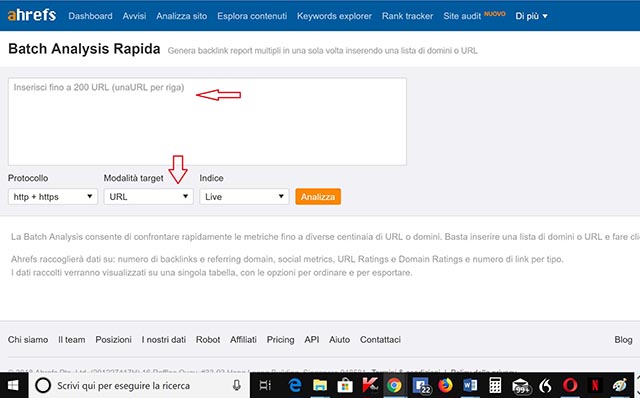
image from ahrefs.com
Buying blogs
A widely used strategy in ecommerce SEO link building. Some abandoned blogs are for sale at a price well below what buying quality links would cost.
Control of the blog and its content can be used both to build links to your site and to promote products and services on it. All you have to do is load the product pages, including in the descriptions a link whose anchor text carries relevant keywords.
Black-hat and grey-hat strategies
As mentioned earlier, although algorithm updates such as Google Penguin can detect them, black hat and grey hat techniques are still practised. The reason is that some of them, done well and by a professional, genuinely work.
Among the most commonly used:
- buying quality links from link farms or marketplaces such as Fiverr (the good ones cost a lot either way);
- mass-inserting links through software in blog and forum comments;
- duplicating content;
- building a network of sites purely to create links;
- building and sending reciprocal links;
- article spinning — rewording existing content with dedicated software;
- cloaking — showing different content or URLs to users than to search engine spiders;
- invisible text — a list of keywords written in white on a white background.
Here’s an interesting video in which Matt Cutts explains the four ways Google evaluates paid links:
Conclusion
In this lesson of your favourite SEO Academy we’ve covered link building. You now have what you need to do link building for free — and otherwise — to build a basic link profile yourself, identify possible link sources and use effective tactics and strategies.
Link building is a process shaped by whatever is happening in SEO, and as you’ve seen it takes time, precision and skill. Updates arrive continuously, so we’ll be returning to these topics in the lessons ahead.
Stay tuned and keep following us — in the next lessons of the SEO Academy we’ll get into plenty more interesting territory…
If you need help with link building, or with SEO in general, or if you want to sharpen your own SEO knowledge — get in touch!
Want to improve your organic rankings through a backlink acquisition strategy? Want to optimize your site, get found by your customers on Google and beat the competition? Get in touch! We’ll work out the best SEO strategy for your site.
Want to sharpen your SEO knowledge? Get in touch! We’ll find the right SEO course for you.
Want to ask us something or just talk to us? Get in touch! That’s what we’re here for.