In this lesson we’re going to talk about Facebook Ads: advertising on Facebook.
As we know, Facebook has a huge user base, with more than two billion people using it.
What does that mean?
Facebook had the bright idea of using its members’ data to let companies and local businesses promote themselves and advertise on Facebook.
Advertising on Facebook has become so important that companies, starting with the biggest and most prominent ones, have decided to pour a serious chunk of their advertising budget into this platform.
Small and medium businesses are also starting to understand how important it is to do advertising on Facebook to reach targeted users and pitch their products and services to them.
Let’s dive right into the world of Facebook Ads.
Need a list of Facebook tools?
Need a tool to schedule your Facebook posts in advance?
Looking for a tool to create quizzes and contests?
Need an analytics tool and want to find out which ones are best?
No problem, we’ll give you the full list. FREE!
Get your free Facebook tools list
Facebook Ads is just another way of saying Facebook Advertising, or advertising on Facebook.
Inside Facebook there’s a panel that gives you the ability to create ad campaigns, plus Facebook Business Manager (you’ll find it here, and we’ll cover it in one of the upcoming lessons) to control and manage multiple ad accounts (very handy, for example, if you’re a web agency managing several client business pages).
So Facebook Ads are campaigns containing advertising on Facebook that can reach your desired target audience.
Why is this possible?
Because Facebook records every action we take from the moment we’re logged in. So if you like one or more gym pages, Facebook will know you’re interested in sports and the gym, and it will be able to serve you targeted ads for any type of service or product a company wants to promote.
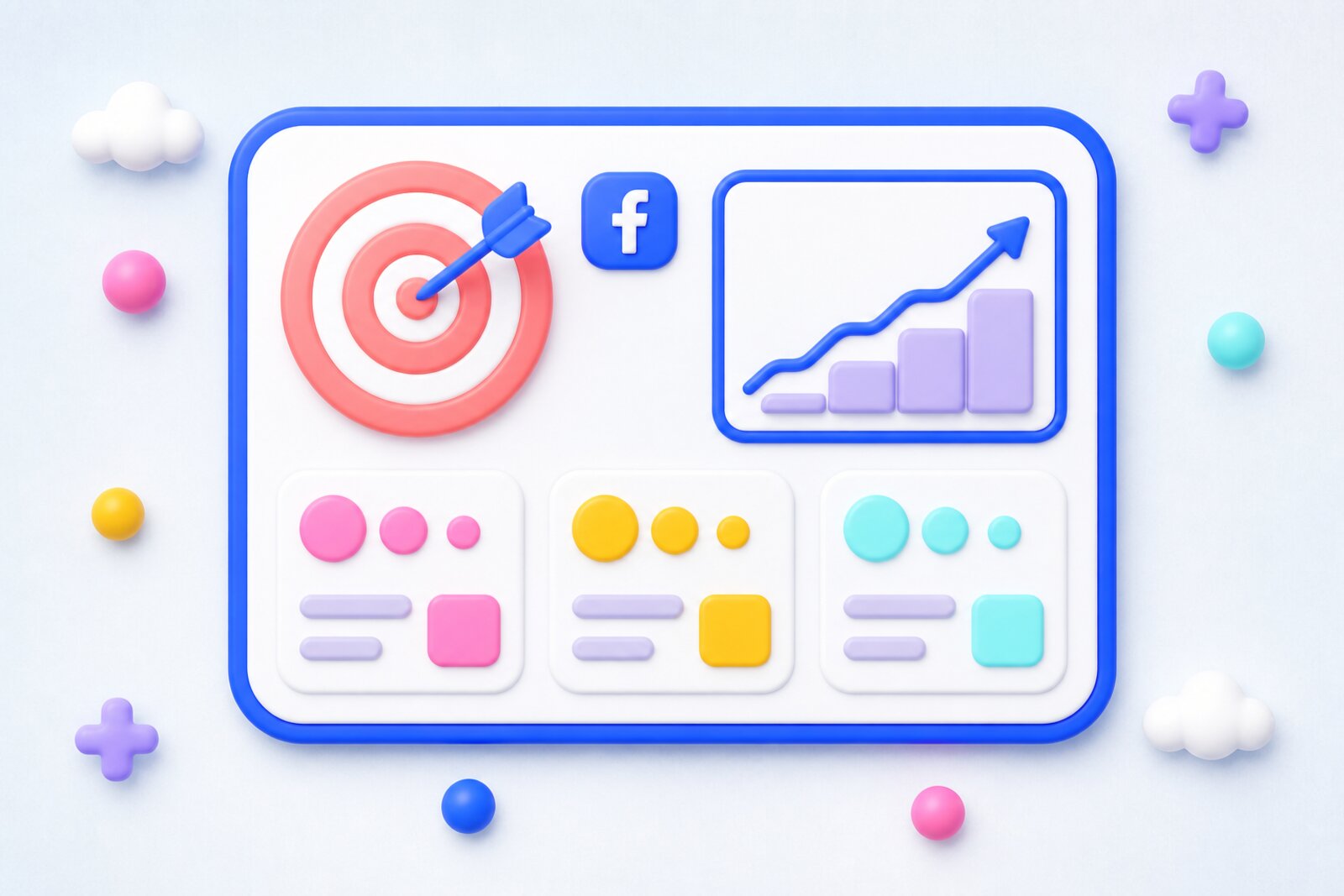
From the moment you decide to advertise on Facebook, you should know that:
- you can create campaigns by location, segmenting by age and gender, adding your target audience’s interests, and even very specific parameters;
- when you create your ads on Facebook, once you’ve entered the parameters of the people you want to reach, Facebook will give you estimates of how many people you can actually reach with your sponsored campaign on Facebook;
- Facebook lets you monitor your campaign results. Make the most of this option, because it’s the only way to improve your performance and your future ad campaigns on Facebook;
- advertising on Facebook works only if your campaigns (ads) are effective and hit the right target audience;
- Facebook advertising costs money, but it can deliver excellent results in terms of revenue and ROI (return on investment), because ads are designed specifically for people with that particular interest.
To be able to advertise on Facebook you need:
- A Facebook profile
- A Facebook page
- A PayPal account or a credit card to pay for the campaign you’re going to run.
So, got everything?
Let’s keep going!
Free Image from Pixabay
Telling you exactly how much advertising on Facebook costs isn’t easy — in fact, I’d say there’s no way to set a figure in advance. It all depends on what you want to achieve: you have different options and different costs depending on the type of campaign you’re going to create.
Facebook Ads are based on an online auction system between advertisers competing to get their ad published. This happens for one reason: users can only see a limited number of ads per day.
Key factors in the Facebook Ads auction:
- the target you choose matters: based on it, you’ll be competing with certain advertisers; your audience is a key factor in getting your ad published;
- Facebook assigns a quality score based on the relevance of your target audience and its response rate. It considers how engaged your audience is with your ad and how it interacts with it. Based on these parameters, the cost of your Facebook advertising campaign will go up or down;
- how competitive your industry is: this is something you’ll need to factor in. The more competitive the sector — meaning there’s a lot of competition offering the same service or product as you — the higher the price;
- watch out for strategic periods like special occasions and holidays: costs will be high.
Need a list of Facebook tools?
Need a tool to schedule your Facebook posts in advance?
Looking for a tool to create quizzes and contests?
Need an analytics tool and want to find out which ones are best?
No problem, we’ll give you the full list. FREE!
Get your free Facebook tools list
Depending on the results you want to achieve, there are different payment models for advertising on Facebook:
- if you want to reach as many people as possible to get your service, product or brand known, you’ll run a CPM campaign (Cost per Mille Impressions). This means you’ll pay for every thousand views of your ad;
- if you want to send people to your website or to a specific landing page, you’ll pay per click: CPC (Cost per Click). So you’ll pay for every click on the campaign link;
- if you want users to take a specific action thanks to the campaign — such as filling out a form, signing up on your site, or buying a product — then we’re talking about Cost per Action: CPA. In this case Facebook will target people who are likely to take certain actions, and you’ll pay every time a user completes the action;
- if you want users to interact with your Facebook ad — meaning they like, comment, share, click — then you’ll pay per Interaction: CPI (Cost per Interaction);
- and one more: if you want to generate useful leads to use later in your business, you’ll pay the Cost per Lead (CPL).
As you’ve seen, there are different campaign setup options with different payment models. You decide what to do based on your goal!
Let’s take a look at the elements advertising on Facebook requires.
Advertising on Facebook is made up of these key elements:
- the ad includes information about the Facebook page that created it, and it flags friends who have interacted with the page (so if one of your friends has, say, liked that page, you’ll see it);
- the page name, which should match the company name;
- the copy, which appears under the company name and is therefore immediately visible to users;
- the visual section: this is an important part of the ad. You can add an eye-catching image or a video that grabs your target audience’s attention;
- the Call to Action. Add the little magic words that should get the user to act. It’s extremely important to have a Call to Action that resonates with your potential customer.
Free Image from Pixabay
At this point I imagine you want to know how to create an ad campaign on Facebook.
First of all, as we mentioned just now, keep in mind that every campaign can look different depending on the goal you want to achieve.
You can decide where you want your ad to be shown, meaning you can choose:
- Ad shown in the desktop News Feed section
- Ad shown in the mobile News Feed section
- Ad shown in Facebook’s right column
- Ad shown across your target Audience Network
- Ad shown on Instagram
Now let’s see how to create your Ad on Facebook:
- From your Facebook profile, click the little down arrow in the top-right bar and you’ll find the Manage Ads option. Alternatively, you can go to Business Manager, which is an external platform, set up your account, click Ads Manager and you’ll end up in the same place.
- As soon as the Facebook Ads window opens, you’ll immediately see a green button in the top right that reads: Create Ad. From this moment on, you’ll be creating your first Facebook sponsored campaign.
- Choose your campaign objective. Keep in mind that a campaign contains ad sets within it, possibly with different target audiences and different creatives, but you’ll try that later on. You have ten objectives available: pick the one that best fits your case.
- Decide on a name for your campaign, then move on to identifying your audience. Facebook gives you plenty of options to define your audience as precisely as possible. You can enter age, gender, spoken language, location, interests, behaviors, people who have already interacted with you. On top of that, Facebook gives you an estimate of how many users you could reach based on your target.
- Choose where you want your Facebook ad to be shown (under Placements)
- Choose a daily budget and how long the campaign will run. You can also pick specific time slots for delivery.
- Create your Facebook sponsored campaign: publish the ad.
The ad will need to go through review, and then you’ll get confirmation that it’s been published.
Facebook campaign statistics
Remember, it’s very important to run an analysis of your Facebook campaign — you’ll need to measure the results and possibly tweak the campaign to improve the effectiveness of your ads.
There’s a dedicated area where you can access the statistics for your ad on Facebook.
Just hover over the campaign you want to analyze and you’ll see the option: View Charts. In this area you’ll have access to all the data related to your campaign, and you can make every evaluation you need!
Now you know how to create a campaign on Facebook — good luck!
Conclusion
In this new lesson of the Facebook Academy you got plenty of information about the business side of things: what Facebook ads are and how they’re created — and beyond that, we tackled the topic of objectives, which are also very important for understanding how to pay for your campaign on Facebook.
Did this lesson help you understand how advertising on Facebook works?
We’ve given you a lot of useful information, which is why you can’t miss the next Facebook lesson. Stay up to date with the lessons of your favorite Facebook Academy!
Want expert Facebook advice? Get in touch! We’ll work out the best Facebook strategy to do whatever it takes to reach your goal.
Want to level up your Facebook skills? Get in touch! We’ll find the right course for you.
Want more info or just want to talk to us? Get in touch! That’s what we’re here for.